
Research
ESPARGOS is built for wireless sensing research. Explore the public CSI datasets we have recorded with ESPARGOS, and the papers, talks and other resources that use it.
Publications and Resources
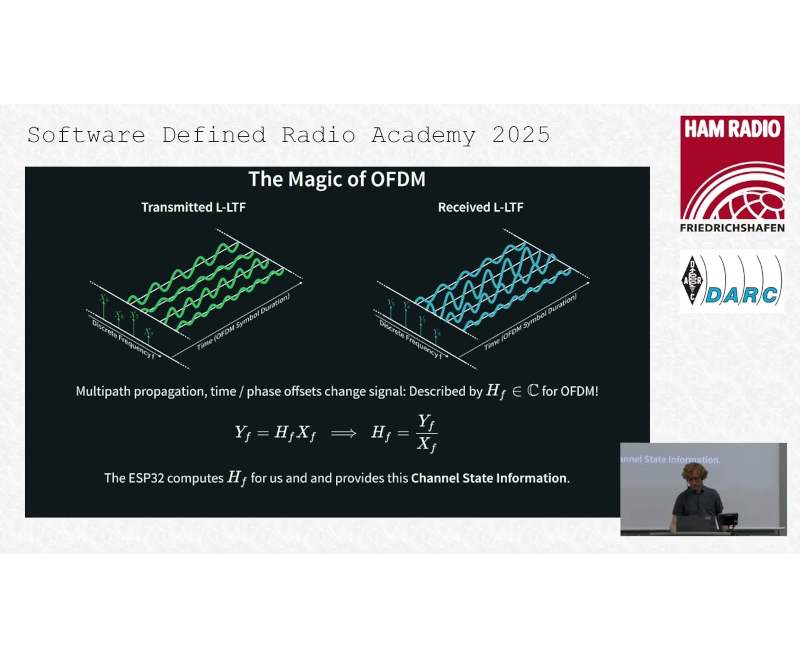
Presentation at SDR Academy 2025
This presentation, given at the SDR Academy during the HAM radio conference 2025 in Friedrichshafen, covers some additional technical details of ESPARGOS.
Watch on YouTube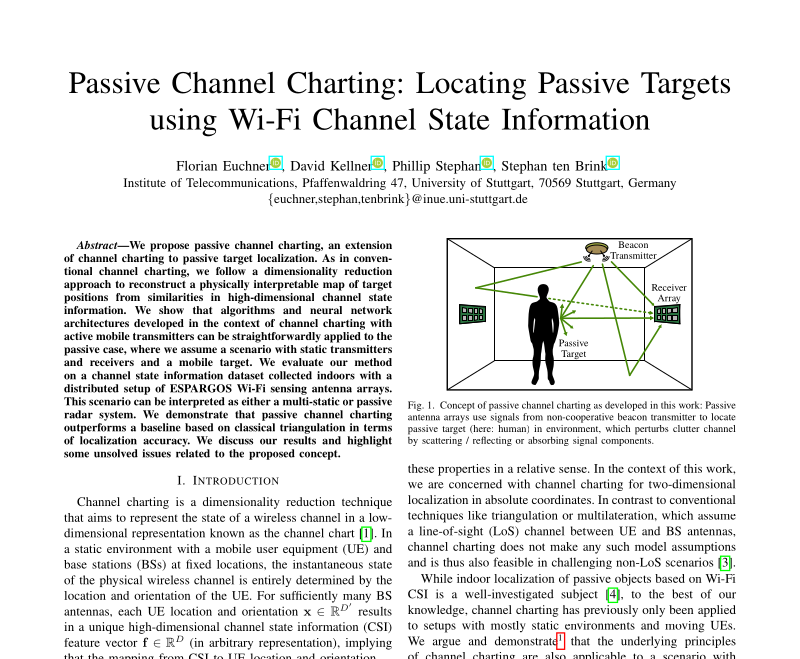
Paper on Passive Channel Charting
In this paper, we propose passive channel charting, a novel passive target localization technique that is, like conventional channel charting, based on dimensionality reduction.
Read on arXiv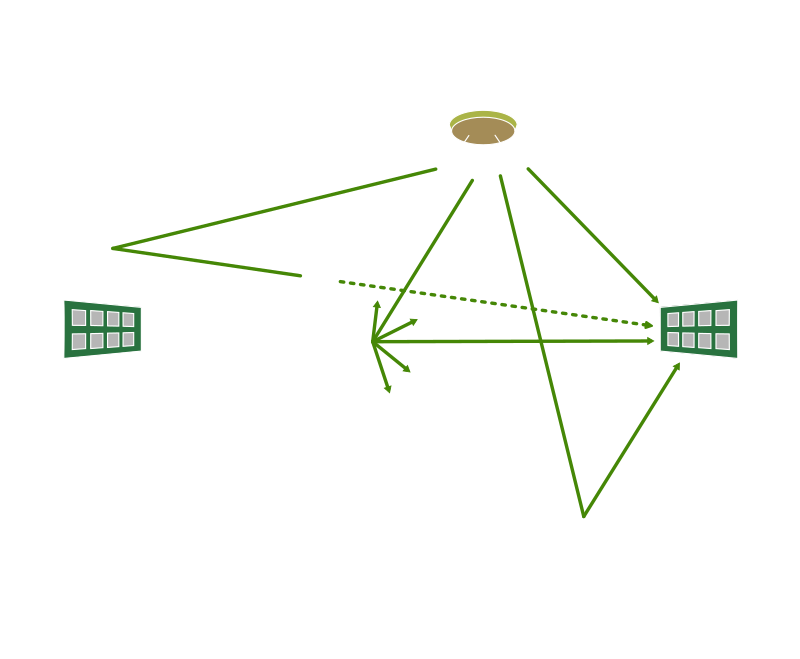
Localization of passive targets (human or robot) based on clasical triangulation or based on two different neural network approaches (supervised or self-supervised "passive channel charting").
View on GitHub
Channel Charting with ESPARGOS
Indoor localization with Siamese Neural Network-based and Triplet Neural Network-Based Channel Charting. Also contains code for triangulation-based localization.
View on GitHub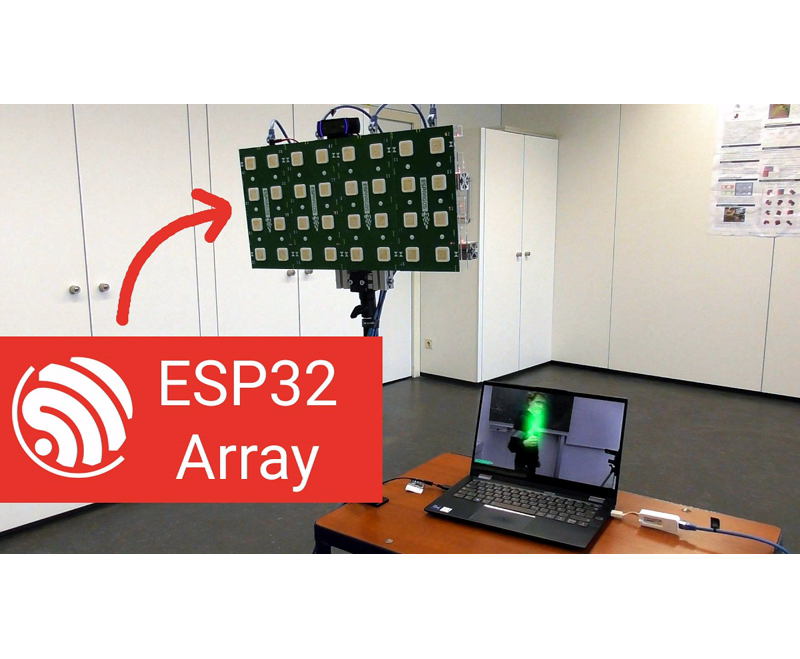
This ESP32 Antenna Array Can See WiFi
A video introduction to ESPARGOS: how an array of ESP32 microcontrollers can be turned into a phase-coherent antenna array that "sees" WiFi signals for wireless sensing and localization.
Watch on YouTube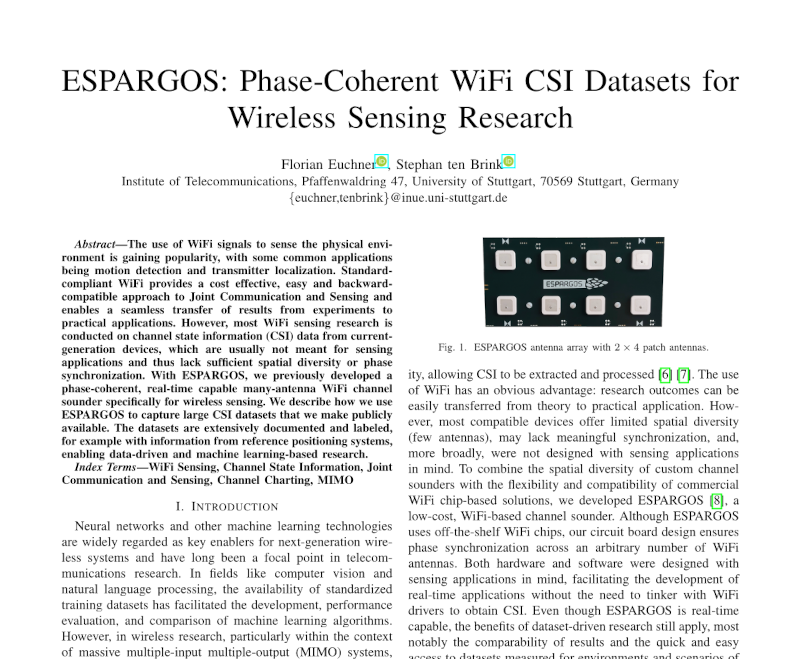
This research paper describes what goes into producing one of our ESPARGOS datasets. It also briefly explains how to apply Channel Charting to one of the datasets.
Read on arXiv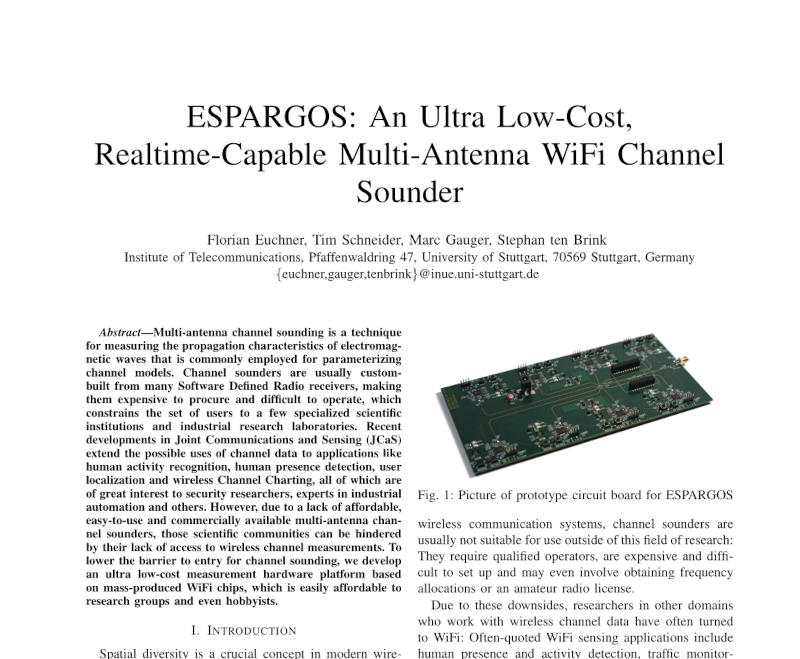
Paper on ESPARGOS Hardware Architecture
This research paper explains how the hardware architecture of ESPARGOS achieves phase-coherence. Despite describing an older hardware revision, the basic explanations and results still apply.
Read on arXivDatasets
Our datasets are collections of channel state information (CSI) measurements created with ESPARGOS for various interesting environments. With our datasets, you can benchmark your CSI-based algorithms without the hassle of setting up experiments and collecting data. Once your algorithms are verified to work on the datasets, you can easily switch over to a real-time implementation with actual ESPARGOS hardware.
ESPARGOS datasets build on extensive experience providing datasets with DICHASUS, which you may want to consider if you need even higher-quality CSI datasets.
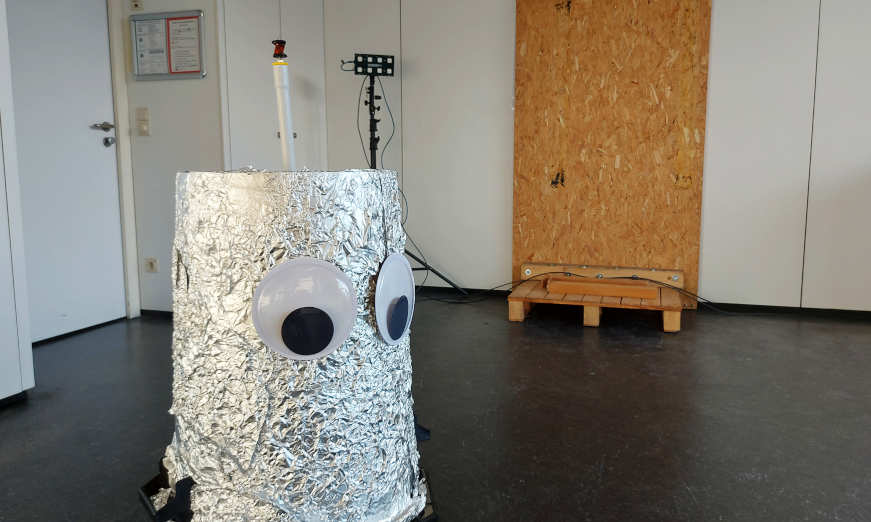
Passive target with four synchronized ESPARGOS antenna arrays in a lab room
A passive target is moving in a lab room, with four time- and phase-synchronous ESPARGOS arrays in the corner and four transmitters on the ceiling. Great for bistatic / passive radar experiments.
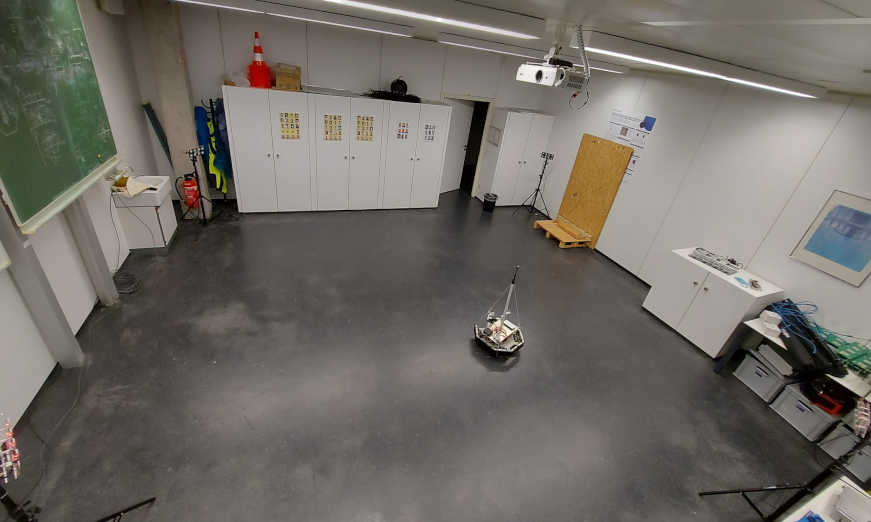
Four phase- and time-synchronous ESPARGOS antenna arrays in a lab room
Four ESPARGOS arrays are placed in the corners of a lab room. Even though they are distributed in space, they are synchronized in both time and phase thanks to wired clock / phase distribution.
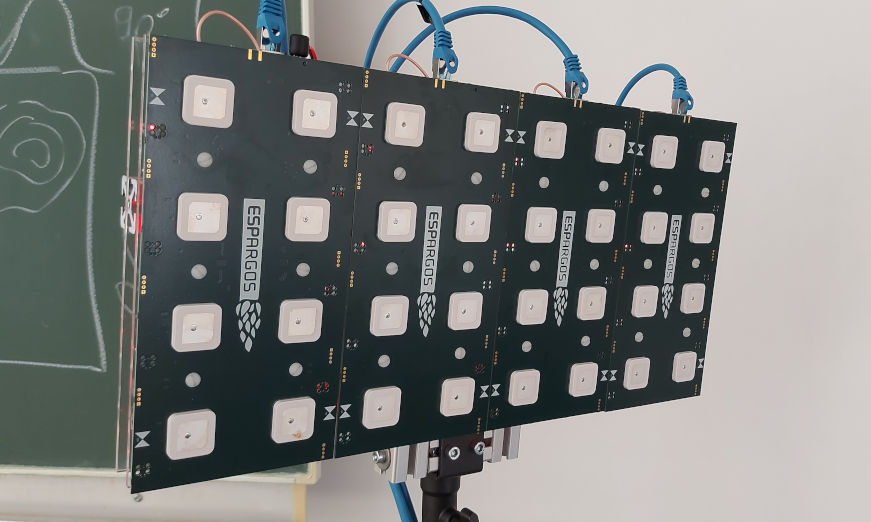
Larger combined antenna array, indoor lab room with metal wall, LoS and NLoS areas
Four ESPARGOS arrays are combined into one large array with 8 by 4 antennas. A metal wall blocks the LoS path in parts of the measurement area. The wall is later removed.
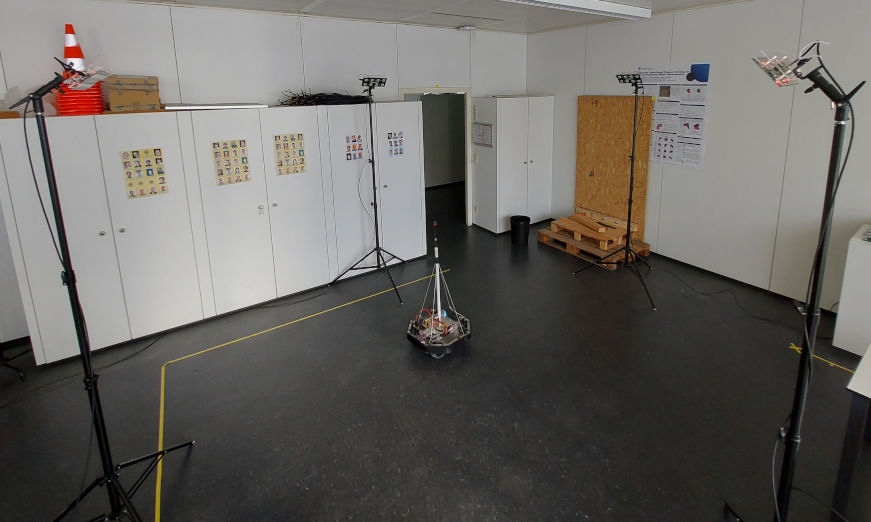
Four antenna arrays in indoor lab room
Four antenna arrays are pointed at a small measurement area in a lab room. Only line-of-sight channels.
Research Application: Real-Time Indoor Localization
ESPARGOS passively measures the phase-coherent CSI of signals from existing WiFi devices like smartphones, robots and other machines, without requiring any changes to those devices.
From these measurements, host-side algorithms can estimate where a device is: in line-of-sight environments by triangulation, or, even without a line-of-sight path, using Channel Charting.
Localization is a research application built on top of the ESPARGOS measurement data (e.g. with pyespargos), not a function of the device itself; it was publicly demonstrated at the Berlin 6G Conference 2024.